NEON BREAKOUT
Mouse or Arrow keys to move paddle · Click or Space to launch
Drag to move paddle · Tap to launch
Mouse or Arrow keys to move paddle · Click or Space to launch
Drag to move paddle · Tap to launch
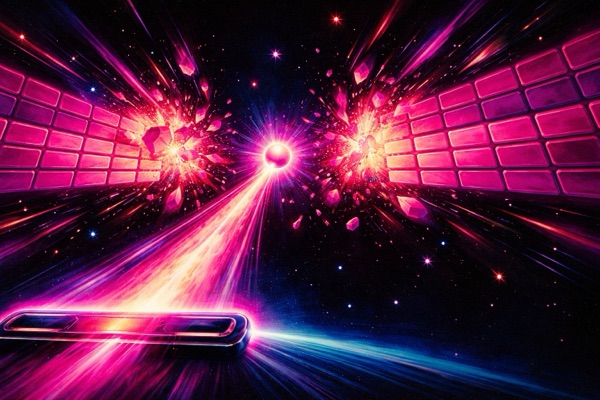
Neon Breakout reimagines the timeless brick-breaker formula with vibrant neon visuals and modern power-ups. Control your glowing paddle to ricochet a ball into rows of colorful bricks, each shattering in a burst of particles. As you clear levels, bricks get tougher (some require multiple hits), the ball accelerates, and power-ups rain down — wide paddle, bonus points, and slow-motion give you the edge you need. The physics-based paddle angling means you control exactly where the ball goes, turning random bouncing into precise destruction. With increasing difficulty across unlimited levels, Neon Breakout tests both your reflexes and your strategic positioning.
Hit the ball with the paddle edge for steep angles that reach bricks tucked in corners. The top two rows always have 2 HP — plan your approach to reach them efficiently. Never chase a power-up if it means missing the ball; losing a life costs more than any power-up gives. The Wide Paddle upgrade resets each level, so use it aggressively while you have it. Focus on clearing one side of the board first to create a channel for the ball to reach the top. Ball speed increases each level, so grab Slow Ball power-ups whenever possible in later stages.
Breakout was originally created by Steve Wozniak and Steve Jobs for Atari in 1976, making it one of the foundational arcade games. The brick-breaker genre evolved through Arkanoid (1986), which added power-ups and enemies, establishing the template that modern versions follow. Neon Breakout continues this legacy with physics-based ball control and a deep power-up system. Fun fact: the original Breakout used no microprocessor — it was built entirely with discrete logic chips. Wozniak designed it using just 44 chips, a feat that impressed even Atari's engineers. The neon visual style transforms this vintage concept into a mesmerizing modern experience.