NEON CENTIPEDE
Arrow keys / WASD to move · Space to fire · X for pulse bomb
Drag to move · Auto-fire · Double-tap for pulse bomb
Arrow keys / WASD to move · Space to fire · X for pulse bomb
Drag to move · Auto-fire · Double-tap for pulse bomb
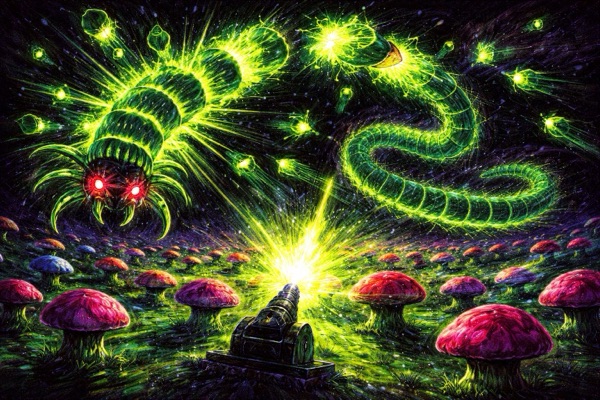
Neon Centipede reimagines the arcade classic with glowing segments, mushroom fields, and relentless multi-segmented enemies that split and scatter when you shoot them. A long centipede weaves through a field of neon mushrooms, changing direction each time it hits one. Your shooter sits at the bottom, firing rapid shots upward to break the centipede into smaller, faster segments. Mushrooms act as obstacles that redirect enemy movement — destroying or creating them changes the centipede's path. Spiders dart across the lower screen, scorpions poison mushrooms (making centipedes dive faster), and fleas drop from above creating new mushrooms. It's controlled chaos in neon.
Shoot the centipede from the head — body segments that detach become independent heads, creating more chaos. Clear mushrooms strategically to create lanes for your shots to reach the centipede. Don't ignore spiders; they score high and clearing them removes a constant threat. Poisoned mushrooms (from scorpions) make centipede segments dive straight down — destroy these mushrooms immediately. Stay in the lower third of the screen for maximum reaction time. When the centipede splits into many small segments, focus on one at a time rather than spraying shots randomly.
Centipede was created by Ed Logg and Dona Bailey at Atari in 1981. Notably, Bailey was one of the first women to design a commercial arcade game. The game was revolutionary for its trackball control and its multi-entity AI — the centipede, spider, scorpion, and flea all behaved independently, creating emergent gameplay complexity. Centipede was also one of the first arcade games to attract a significant female audience, challenging the male-dominated arcade culture of the era. Neon Centipede preserves these innovative gameplay systems while adding modern visual effects that make each segment glow and pulse with life.